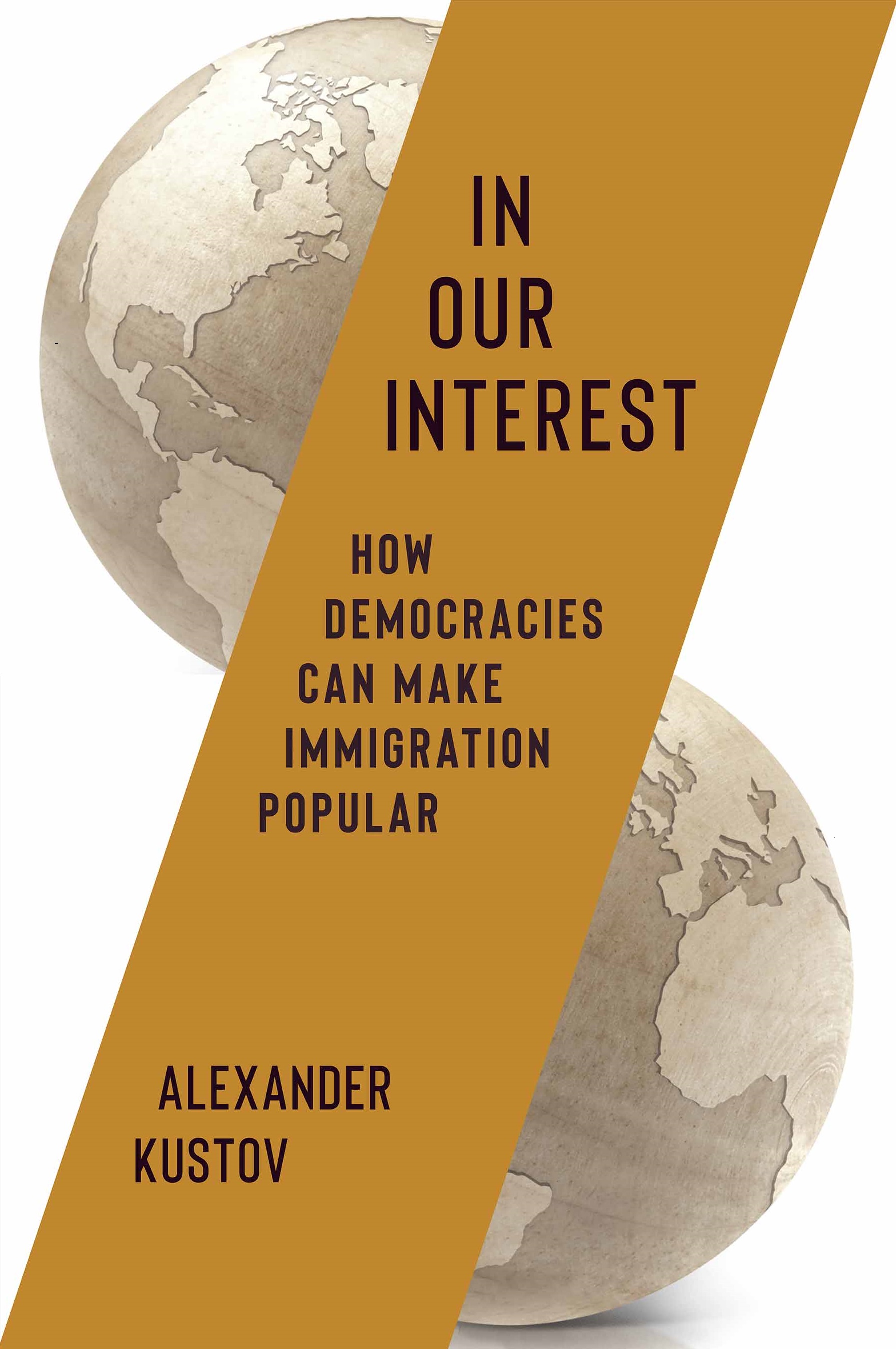
I am an Associate Professor in the Keough School of Global Affairs at the University of Notre Dame. I study public opinion and democratic governance with a focus on managing immigration, ethnic tensions, and other demographic issues in high-income countries. I specialize in computational and experimental methods, drawing on diverse data sources from surveys to historical records. My book In Our Interest: How Democracies Can Make Immigration Popular (Columbia University Press, 2025) examines under what conditions most people would accept freer immigration despite their biases.
My research has been published in American Political Science Review, British Journal of Political Science, Comparative Political Studies, Journal of Politics, Perspectives on Politics, and World Politics. It has been recognized by leading grants and awards, including from the Russell Sage Foundation, American Political Science Association, and Department of Defense Army Research Office. I have also written for The Washington Post and Foreign Affairs, and been featured in The New York Times, Economist, Atlantic, and Financial Times, as well as by think tanks such as the Bipartisan Policy Center, Center for Global Development, and Niskanen Center.
Currently, I am the author of the Popular by Design newsletter and a contributor at Good Authority. Prior to my appointment at Notre Dame, I was an Assistant Professor at the University of North Carolina and a Postdoctoral Associate in the Jackson School of Global Affairs at Yale University. I received my joint Ph.D. in Politics and Social Policy from Princeton University. I can be reached at akustov [at] nd [dot] edu. You can find my CV here.

Select Articles
Kustov, Alexander and Michelangelo Landgrave. 2025. Immigration is Difficult?! Informing Voters About Immigration Policy Fosters Pro-immigration Views. Journal of Experimental Political Science.
Abstract The US public is mostly ignorant about basic immigration knowledge. While various attempts to correct misperceptions have generally failed to change people's minds about the issue, it is possible that this failure has been the result of not providing relevant information. We argue that informing the public about the difficulty of the legal immigration admission process is an effective, perspective-changing way to raise support for more open immigration policies. We test and confirm this hypothesis using a nationally representative US survey experiment (N = 1000) that informs respondents about US immigration's administrative burdens and restrictions through short verifiable narratives. We also provide the first evidence of the widespread ignorance about the immigration process across diverse political and demographic groups. Our results suggest that providing a better understanding of the immigration process' difficulty has more promise to change public policy preferences than challenging skeptics' crystallized beliefs about immigration's effects or numbers.
Kustov, Alexander. 2025. Beyond Changing Minds: Raising the Issue Importance of Expanding Legal Immigration. Perspectives on Politics. 23 (4): 1444-1463.
Abstract How can public opinion change in a pro-immigration direction? Recent studies suggest that those who support immigration care less about it than those who oppose it, which may explain why lawmakers do not enact pro-immigration reforms even when voters are pro-immigration. To see if the personal issue importance of immigration can be changed, I conducted a probability-based, nationally representative US survey experiment (N = 3,450) exposing respondents to verifiable arguments about the broad national benefits of expanding legal immigration and the costs of not doing so. Using new measures of issue importance, my descriptive results show that only one-fifth of voters who prioritize the issue have a pro-immigration preference. Furthermore, while anti-immigration respondents prioritize policies regarding law enforcement and (reducing) future immigration, pro-immigration respondents prioritize (helping) immigrants already here. The experimental results confirm that the provided arguments raised immigration's importance among pro-immigration voters but did not backfire by mobilizing anti-immigration voters. Contrary to expectations, the arguments increased pro-immigration policy preferences, but did not change voters' subissue priorities within immigration or their willingness to sign a petition. Overall, the treatment was effective beyond changing minds by shifting stated issue positions and priorities in a pro-immigration direction. It can thus be used in a nontargeted information campaign to promote pro-immigration reforms.
Kustov, Alexander. 2023. Do Anti-immigration Voters Care More? Documenting the Issue Importance Asymmetry of Immigration Attitudes. British Journal of Political Science. 53 (2): 796-805.
Abstract Why do politicians and policymakers not prioritize pro-immigration reforms, even when public opinion on the issue is positive? This research note examines one previously overlooked explanation related to the systematically greater importance of immigration as a political issue among those who oppose it relative to those who support it. To provide a comprehensive empirical assessment of how personal immigration issue importance is related to policy preferences, I use the best available cross-national and longitudinal surveys from multiple immigrant-receiving contexts. I find that compared to pro-immigration voters, anti-immigration voters feel stronger about the issue and are more likely to consider it as both personally and nationally important. This finding holds across virtually all observed countries, years, and alternative survey measures of immigration preferences and their importance. Overall, these results suggest that public attitudes toward immigration exhibit a substantial issue importance asymmetry that systematically advantages anti-immigration causes when the issue is more contextually salient.
Kustov, Alexander, Dillon Laaker, and Cassidy Reller. 2021. The Stability of Immigration Attitudes: Evidence and Implications. Journal of Politics. 83 (4): 1478-1494.
Abstract Do voters have stable immigration views? While any account of immigration politics must make an assumption about whether underlying attitudes are stable, the literature has been ambiguous regarding the issue. To remedy this omission, we provide the first comprehensive assessment of the stability and change of immigration attitudes. Theoretically, we develop a framework to explicate the temporal assumptions in previous research and find that most studies assume attitudes are flexible. Empirically, we draw on nine panel data sets to test the stability question and use multiple approaches to account for measurement error. We find that immigration attitudes are remarkably stable over time and robust to major economic and political shocks. Overall, these findings provide more support for theories emphasizing socialization and stable predispositions rather than information or environmental factors. Consequently, scholars should exercise caution in using changing context to explain immigration attitudes or in using immigration attitudes to explain political change.